
temporalities
The Sixth Annual Critical Femininities Conference
Call for Committee Members:
The Critical Femininities Network is calling for new committee members to join the conference planning committee for the sixth annual Critical Femininities Conference on the theme of ‘Temporalities’. The conference will take place virtually on August 7-9, 2026.
Temporalities refers to the state of existing within or having some relationship to time. In what might be referred to as unprecedented times, uncertain times, or even the worst possible timeline, femininity has the potential to expand our temporal horizons and offer new possibilities. Critical conceptions of femininity can help us reach to the temporal fringes to de-centre patriarchal, colonial, white supremacist, cisheteronormative, capitalist, anti-fat, ableist, and other oppressive temporal frameworks.
Critical Femininities is a growing field that seeks to develop nuanced critiques of femininity in all its variations. Those who work in Critical Femininities aim to go beyond its characterization as a patriarchal imposition. A key aspect of Critical Femininities analysis is an understanding that femininity is not synonymous with ‘woman’ (Dahl 2012, Taylor & Hoskin 2023, 79). In addition to elucidating and theorizing feminine and femme identities, Critical Femininities scholars follow traditions in non-academic femme writing, including feminist, queer, antiracist, and decolonial scholarship to understand femininity as subversive, to understand femme-ininity as a theoretical framework, and a mode of knowledge production. The intersections of research, writing, art, and performance are all sites to understand femininity beyond identity as affective, assemblage, and lineage. The Critical Femininities conference has previously been organized around the themes of “Excess,” "Liminal," "Irreverence,"“Generation,” and “Connection.”
Read more about past themes and conferences here.
Committee members will be involved in reviewing conference abstracts, writing funding proposals, managing the conference’s social media, programming keynote and workshop sessions, and organizing the conference schedule. The committee typically meets once per month. We welcome letters of interest from experienced conference organizers and new organizers looking to build their skills.
*committee members are still welcome to present during this year’s conference.
Committee member positions
Note: all committee members are expected to support the weekend of the conference with chairing and technology support. If you are unable to offer support for the weekend of the conference, please note this in your application. Please specify in your application which committee member position you are applying for.
Social media
The social media members are expected to, in collaboration with other committee members, support the promotion of the conference digitally, primarily on the Instagram account. This will include writing copy, adding alt-text, and scheduling posts to promote the CFP (call for papers), the conference speakers and schedule, and conference registration. They will also help keep the conference website up-to-date with current information. Experience managing a social media account is preferred; please note what type of experience you have when applying.
Communications, writing and design
Communications writing and design members, in collaboration with the social media members, support the promotion of the conference via the creation of graphics, posters, and email communications. Experience with Canva or another design software is preferred; please note what type of experience you have when applying.
Funding
This role involves finding and applying for funding opportunities to keep the conference free for attendees, support the accessibility of the conference, support the continuation of the conference, and facilitate honorariums for committee members, the keynote speaker, and the workshop facilitator. Experience writing grant funding applications is preferred; please note what type of experience you have when applying.
General committee members
General committee members will help with additional conference duties, including taking minutes at meetings, taking on duties at meetings, and supporting the conference weekend through chairing sessions and providing tech support.
How to apply
Please send your CV and a short statement (maximum one page) outlining your interest and/or experience in the conference theme and organizing duties to critfemininities@gmail.com by February 20, 2026.
If you have any questions, please contact us at critfemininities@gmail.com.
past conferences

Excess, August 19-22, 2021.

Liminal, August 25-28, 2022.

Irreverence, August 17-20, 2023.
Generation, August 16-18, 2024.

Connection, August 15-17, 2025.
-
Connection: joining, uniting, fastening, bringing together. Audre Lorde highlighted how when we “make connection with our similarities and our differences” (53), we remind ourselves of our own and others’ affective capacity. Femininity can be a rich and creative site of connectivity that expands beyond colonial imaginaries of womanhood and gender. Critical femininities is a site where we can connect, disconnect, and reconnect with the world, each other, and our own gendered selves. Connections can be tangible and intangible, with these boundaries being increasingly blurred as technologically mediated communication methods saturate our lives.
-
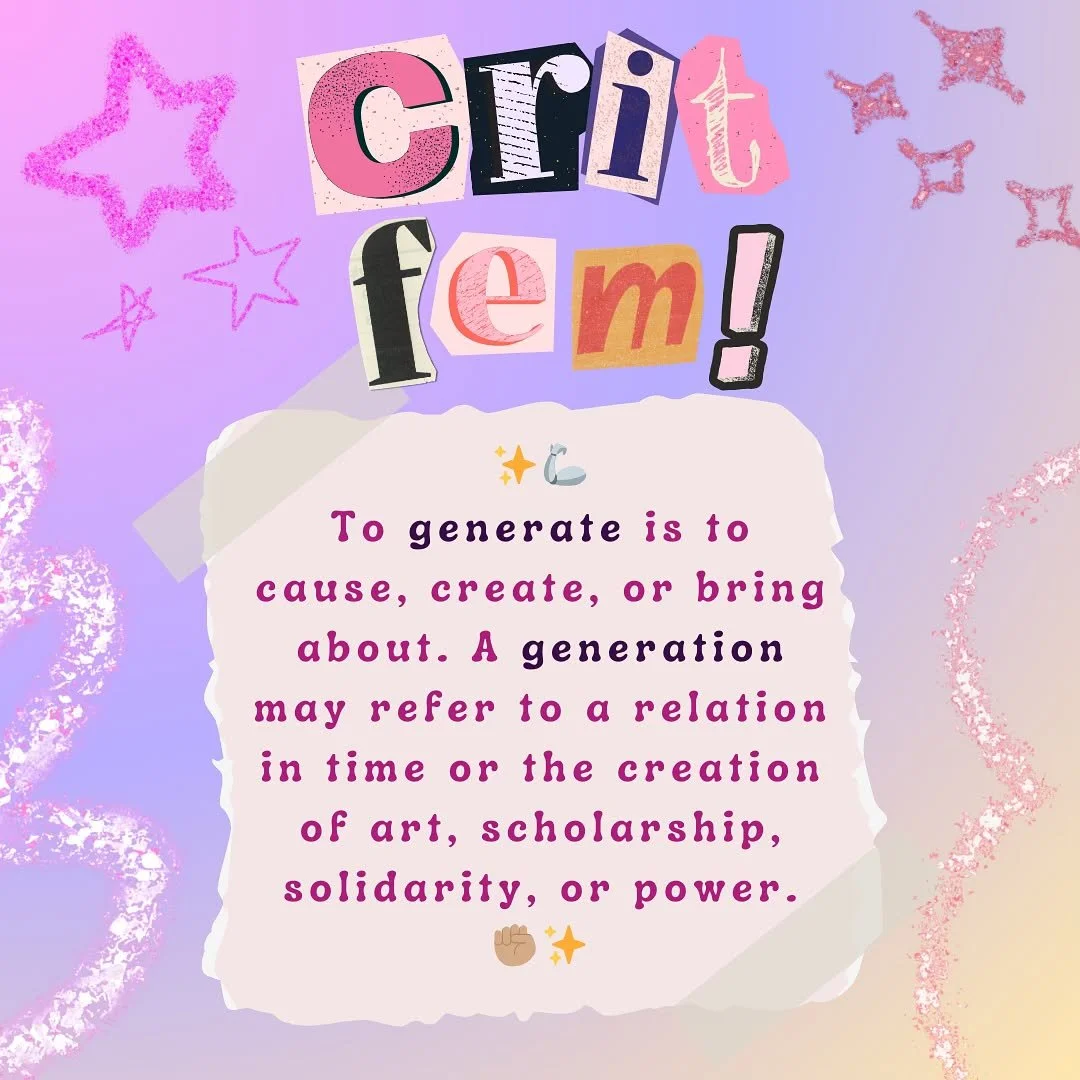
To generate is to cause, create, or bring about. A generation may refer to a relation in time or the creation of art, scholarship, solidarity, or power. This conference aims to explore the multifaceted dimensions of and attitudes towards femininity across different generations, interrogating how various social, cultural, political, and technological factors intersect with and shape our experiences. In this moment of intergenerational conflicts, climate crisis, and generative AI, the time has come to think critically about our generations and what we generate.
Critical femininities as a discipline and praxis rethinks feminine embodiment under heteropatriarchy and provides an entry point to reclaiming femmeness as an intersectional, complex and generative subjectivity (McCann 2018; Hoskin and Blair 2022; Taylor and Hoskin 2023). The generative aspect of femininity reveals the multidimensional modes of resistance and power that arise in taking up femme identity. Femme and femininity hold generative potentials that are not restrained to regulatory discourses of lack, shame, or failure. In rethinking femininities and generation, we harken the affective aspects of femme-becomings, accounting for the creative energy that comes with “what a femme body does,” rather than the notion of ‘what a femme body can do’ we have adhered to under systems of oppression (McCann 2018, 118). An affective perspective on femme embodiment and generations offers radical possibilities for femme to be experienced and lived through messy, artful and bodily practices (Athelstan 2015; Kafai 2021; Schwartz 2018).
Feminism has often been chronicled throughout history as a series of generational waves, each with its own distinct approach to gendered issues and its own understanding of femininity (Hemmings 2011; Rampton 2015). While this wave framing has been critiqued as exclusionary of Black feminists and other marginalized groups (Springer 2002), there remains a strong scholarly interest in the intergenerational feminine and feminist solidarities that extend beyond temporal boundaries (Purvis 2004). Expanding beyond bioessentialist notions of family, queer communities and scholars have found ways to envision alternative generational kinship structures that eschew heteronormative nuclear family dynamics, especially resisting the limiting performances expected of femmes and feminine subjects (Eguchi and Long 2018). BIPOC, Queer, Trans, disabled and femme interventions and critiques of the lineages defined by patriarchy, white supremacy, and colonization disrupt hegemonic ideologies that have made these subjects simultaneously hypervisible and invisible in the fabrics of society. Thus, the theme of ‘generation’ is an act of epistemic resistance to centre voices that have been erased for so long and disrupt taken-for-granted assumptions about what it means to create or bring about.
Organizing Committee: Hannah Maitland, Mackenzie Edwards, Kathleen Cherrington, Allegra Morgado, Ramanpreet Bahra, Alicia Delima, and Laxana Paskaran.
-
To be irreverent is to show disrespect where respect is demanded, to be flippant in the face of serious situations, and to satirize what others hold sacred. In western culture, the mother, the virgin, and the queen are figures of femininity that are often held sacred, exemplifying the entrenchment of idealized feminine characteristics such as domesticity, piety, and (hetero)sexual or moral purity. But for decades, irreverence has been woven into camp and poststructuralist approaches to femme theory, which insist that femme is an intentionally ironic performance of this idealized white, cis-heterosexual femininity (Albrecht-Samarasinha 1997; Case 1988; Duggan & McHugh 1996). Irreverent attitudes toward femininity—especially white, heterosexual, and colonial femininities—are also integral to other queer cultures and modes of critique: in recent years, hypersexual and outrageous impersonations of the sacred feminine figures the Virgin Mary and Queen Elizabeth (I and II) have been presented on the mainstage of TV’s Rupaul’s Drag Race. In this way, irreverence has wrought countercultural styles of femininities that relate to punk, drag, sex work, working-class, Indigenous, and racialized sensibilities (Bailey 2014; Chepp 2015; McCann 2016; Padaan 2023).
As the mainstreaming of femme has converged with postfeminist culture, the exaggerated feminine aesthetics associated with femme and other feminine subcultures are increasingly normalized and celebrated, leading to phenomena like: the success of reality TV stars and social media influencers; the rise of bimbo theory; and the imminent resurgence of Barbie. While such phenomena are often scrutinized as anti-feminist and frivolous, they also create space for queer and femme joy, and potentiate both the conceptualization of gender affirmation and the extension of critical femininity discourse beyond LGBTQ+ contexts. At the same time, these phenomena raise questions about: the appropriation of Black cultures and sex worker aesthetics without recognition or political solidarity; the sexism, racism, and fatphobia embedded in western beauty culture; and postfeminism’s undermining of feminist politics (Banet-Weiser 2018). Roxane Gay’s “bad feminist” framework offers one way to navigate such contradictions, acknowledging that we may, occasionally, break with feminist dogma in recognition of our flawed humanity and the pursuit of personal joy.
Importantly, Sara Ahmed’s (2010) figures of the “feminist killjoy” and “affect alien” demonstrate that irreverence is not always gleeful or flippant. On the contrary, it can render serious political critique. As critiques of anti-Black racism, settler colonization, imperial capitalism, and cisheteropatriarchy have become a part of mainstream political discourse and more embedded within cultural and artistic institutions, the ways in which irreverence has historically sustained queer of colour critique, art, fashion, and literature have become more visible, drawing greater attention to how irreverence encourages both the critique of white, western, cishet femininity, and a focus on femininities that exist outside of this normative ideal.
Organizing Committee: Andi Schwartz, Hannah Maitland, Jade Crimson Rose Da Costa, Kathleen Cherrington, Mackenzie Edwards & Maisha Mustanzir
-
To be liminal is to be in between or in transition; on the threshold of the sensory, the liminal may produce both hauntings and longings. We present the concept of “femininity” as liminal or palimpsestic itself (Alexander, 2005), inseparable from the ongoing echos of cisheteropatriarchy, colonization, white supremacy, capitalism, ableism, and fatphobia that interpellated it (Brownmiller, 1984; Bordo, 1993; Davis, 1983; Deliovsky, 2008), as well as animated by the simultaneous reverberations of feminist, Black, Indigenous, racialized, trans, and queer interventions which create more capacious futures for femininity (Lorde, 1984; McCann, 2018; Muñoz 1999; Nash, 2011; Rice, 2009; Shraya, 2018). Julia Serano’s (2008) foundational work on transfemininity reveals femininity’s impermanence and malleability, both socially and scientifically (re)constructed. These critical undertakings permit an understanding of femininity as an embodied site of many assemblages and temporalities, transforming it (as well as gender writ large) from a modality of imperial domination into a place of past-present-future becoming and a practice of transgenerational kinship. How might we understand femininity as nonlinear, transitory, and transformative? How might patriarchal phases of femininity be contested or reclaimed?
The field of critical femininities, too, is liminal; still an emergent discipline, critical femininities draws from multiple sites of knowledge and knowledge-production. Femme theory springs not from academia but from the lineage of femme and queer feminist life-writing, often in memoir or edited anthologies that include a range of forms—essays, poetry, art, and photographs (Brightwell & Taylor, 2021; Hollibaugh, 2000; Lorde, 1984; Nestle, 1987, 1992; Pratt, 2005; Schwartz, 2018). The year 2022 presents an opportunity to reflect on the lineage of critical femininity studies; it marks 20 years since the publication of Brazen Femme: Queering Femininity (2002), edited by Chloë Brushwood Rose and Anna Camilleri, and follows the passing of prolific Black feminist bell hooks, whose writing on feminism, belonging, and love gets to the heart of what motivates the generation of critical femininities. The present is an eternally liminal space, caught between past and future; between settler colonialist-white supremacist-cisheteropatriarchal-capitalist histories and the worldings of radical love and transformation still possible.
Organizing Committee: Andi Schwartz, Hannah Maitland, Jade Crimson Rose Da Costa, Ruth O’Sullivan & Kathleen Cherrington
-
“Excess” is the grammar of camp style. It is the signifier of capitalism, the name of inequality, and a warning of environmental collapse. “Excess” is the abject and the affective — those feelings, affects and embodiments that “spill over”, which exceed white supremacist, heteropatriarchal, ableist, and cissexist frameworks of recognition or normative logics of acceptability. Insofar as femininity, and femme, are excessively embodied, excessively artificial, and excessively emotional, “excess” is the charge against femininity — but also its potential resistance. We contend that a critical femininities framework — which moves beyond accounts of (heterosexual) femininity as a site of patriarchal control to unhinge femininity from “woman” and “female” and understand the feminine as a site and form of knowledge (Dahl, 2012) — foregrounds the ways that “excess” and practices of exceeding are mobilized by marginalized communities as strategies of resistance, survival, and celebration. Critical femininities frameworks can be mobilized to frame the politics of excess as potentially emancipatory, opening up the possibilities of queer (femme) futurities, pleasures, protests, and practices of care (Brushwood Rose & Camillieri, 2002; Dawson, 2017; Hollibaugh, 2000; McCann, 2018; Nestle, 1992; Schwartz, 2016, 2018, 2020; Volcano & Dahl, 2008).
As an interdisciplinary and burgeoning body of thought, a critical femininities framework “exceeds” the boundaries of the academy; Ulrika Dahl (2012) writes, “Equipped with differential consciousness and attending to both pleasure and pain, we might lose the (academic) masculinity complex” (p. 63). We contend that critical femininities, then, offers especially useful entry points into examining how excess orients and drives existing systems of accumulation to the detriment of multiply marginalized communities, often framing these communities as pathological and immoral (Russo 1995; Skelly 2014; Musser 2019), as well as how these communities engage in practices of (potentially joyful) resistance, survival, and care. While excess orients and drives existing systems of capitalist accumulation, it is simultaneously weaponized as pathology and immorality against historically marginalized groups. Jane Skelly writes that “like decadence, the term ‘excess’ has often been used to shame and/or control that which threatens the social order” (2018 p.4): the excessively embodied, excessively emotional, and excessively abject — those traits so closely associated with femininity — only exist in relation to the norms they transgress (Russo, 1995; Skelly, 2014; Skelly, 2018). At the same time, “excess” has been mobilized by marginalized communities as strategies of resistance, survival, and celebration — through expressions of camp, femme, and the field of critical femininities itself.
Critical femininity studies can be understood is its own form of resistance through its embrace of the abject; Dahl (2012) asks, “how might we (re)figure critical femininity studies as centered on that which has always seemingly been the abject antithesis of our very intellectual existence, the speculum of (queer) femininity beyond a simple story of subordination, sexualization, objectification, and superficial narcissism?” (p. 61). Within queer theory, camp has been framed as a modality of reclaiming excess, rendering the “politics of excess” as a practice of resistance. Fabio Cleto (1999) suggests that camp represented a survival strategy vis á vis stigma; it cemented solidarity among queer men coping with a hostile reality, and “celebrated the power of style, make-believe, and crafted arabesques of indirect self-expression” (p. 35). Similarly, Andrew Ross (1989) positions camp as part of a survivalist culture that found a way of imaginatively expressing its common conquest of everyday oppression.
Femme is sometimes understood as a camp version of femininity (Case, 1988), similarly reclaiming, mocking, and subverting the excess of femininity (and even gender itself). In all its excess, passivity, and artificiality, femmes have understood femininity as a mode for sexual healing, wholeness, and other pleasures (Nestle, 1992; Albrecht-Samarasinha, 1997; Cvetkovich, 2003; McCann, 2018); a method to queer and subvert gender (Duggan & McHugh, 1996; Hollibaugh, 2000; Brushwood Rose & Camilleri, 2002; Hoskin & Taylor, 2019); a catalyst for community formation (Volcano & Dahl, 2009; Connell, 2012; Nicholson, 2014; Schwartz, 2016, 2020); and a site of politics and theory (Dahl, 2012, 2014; Brightwell, 2017; Dawson, 2017; Schwartz, 2018, 2020; Hoskin, 2017, 2019; Brightwell & Taylor, 2019; Scott, 2019).
While femme is already many things and excess is already too much, we seek to expand the dialogue around femininity, femme, excess, and the possibilities and limits of both. We seek proposals for panels, papers, and other presentations that explore the possibilities, limitations, poetics, aesthetics, and politics of fem(me)inine excess and an excess of fem(me)ininities.
Organizing Committee: Andi Schwartz and Sarah Redikopp